Imagine a pharmaceutical company launching a new medicine.
In most industries, identifying the customer is relatively straightforward. Someone wants a product, decides to buy it, and pays for it.
But who is the customer when that product is a prescription medicine?
Is it the patient who needs it? The physician who prescribes it? The pharmacist who dispenses it? The hospital that administers it? Or the insurance company that pays for it?
The answer depends on the question we’re trying to solve.
And that is where pharmaceutical customer analytics becomes interesting.
One medicine, many decision-makers
Let’s introduce NovaMab, a fictional medicine entering a competitive pharmaceutical market.
Its commercial team wants to understand how the product is reaching the market. But the journey from a medicine becoming available to a patient receiving treatment involves several participants.
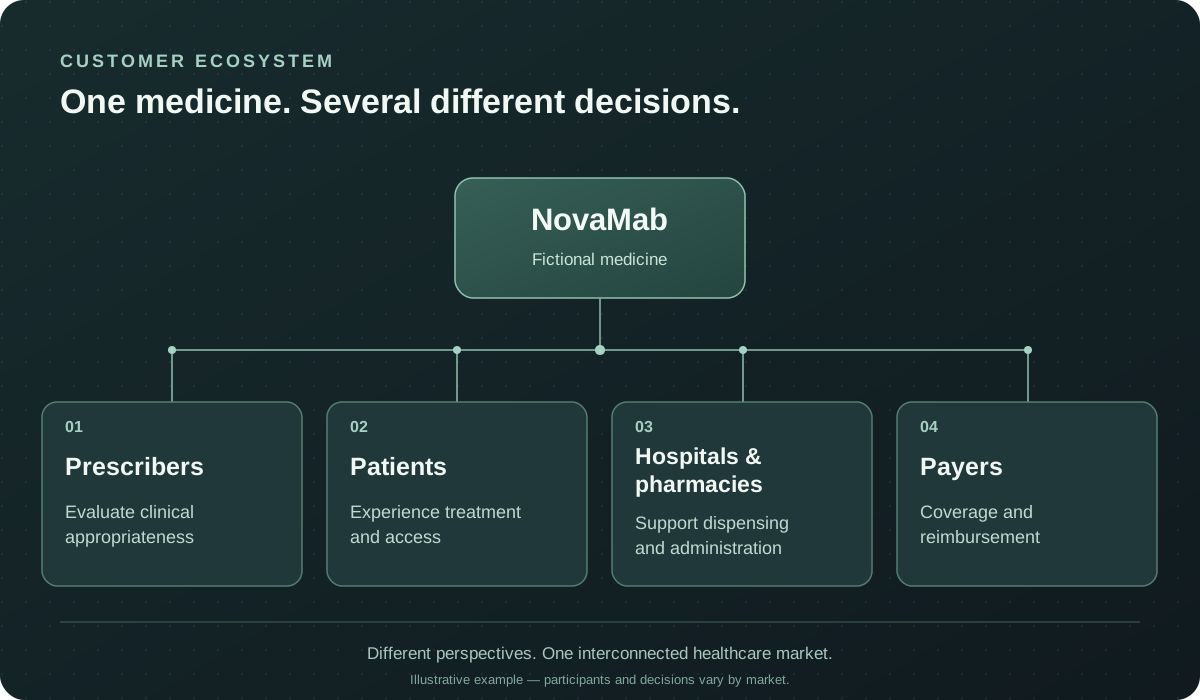
One medicine, several decision-makers. The participants and their roles vary across pharmaceutical markets.
A physician evaluates whether NovaMab is clinically appropriate for a patient. The patient may encounter practical or financial barriers to receiving treatment. Hospitals and pharmacies have their own processes, while public or private payers may determine coverage and reimbursement.
Each participant influences a different part of the treatment and access journey.
For pharmaceutical commercial teams, healthcare professionals (HCPs) are often an important customer group. But understanding HCPs without understanding their wider market can produce an incomplete picture.
So what does customer analytics actually mean?
In simple terms, customer analytics uses data to understand customer characteristics, needs, interactions, and behaviour so that an organization can make better-informed decisions.
In pharmaceutical commercial analytics, teams might ask:
- Where are the relevant HCPs and potential patient populations?
- How do prescribing patterns vary between territories?
- Which HCPs have received permitted scientific or commercial engagement?
- How is a product performing relative to the wider market?
- Are access restrictions or product availability affecting observed performance?
These are different questions, and answering them requires different datasets.
Knowing the customer is not the same as understanding the market
Suppose NovaMab’s commercial team notices that two territories have the same number of HCPs but very different prescription volumes.
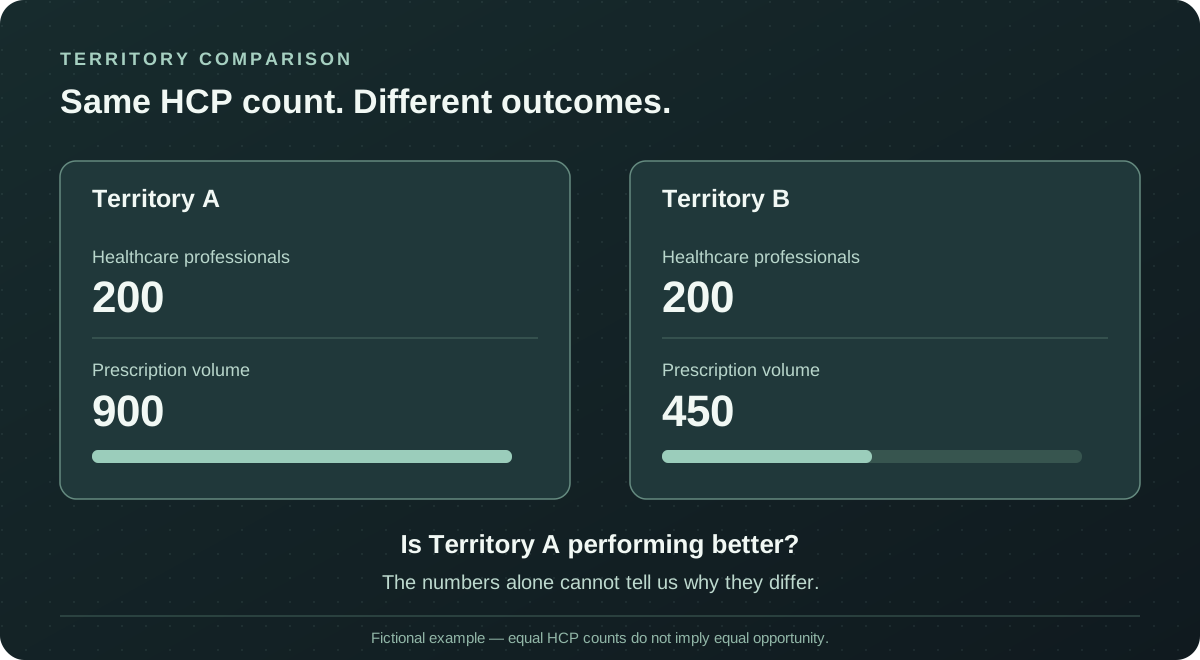
Two territories with identical HCP counts but different prescription volumes. Without additional market context, the numbers tell only part of the story.
Territory A has 200 HCPs and records 900 prescriptions during the quarter.
Territory B also has 200 HCPs but records only 450 prescriptions.
Is Territory A performing better?
Perhaps. But there are other possibilities.
Its HCPs may treat more eligible patients. Product availability may differ. Coverage conditions may be more favourable. The two territories may have different specialty mixes, treatment patterns, or competing products.
A prescription count tells us something about what happened. It does not, on its own, explain why.
Understanding the difference requires connecting customer information with market, product, access, and activity data.
The real challenge begins with the connections
In pharmaceutical commercial analytics, information is often spread across customer master data, CRM systems, market research, prescription datasets, and other sources.
Each contains part of the story. None necessarily provides the complete picture.
Bringing those perspectives together is what turns individual customer records into useful commercial insight.
Even then, analysis needs appropriate safeguards. Patient privacy, clinical independence, data limitations, and rules governing pharmaceutical engagement all matter. An observed relationship between two activities does not automatically mean one caused the other.
Ultimately, customer analytics is not simply about producing more reports.
It is about asking better questions, connecting the right information, and understanding the limitations of the answers.
The idea to take away
In pharma, understanding the customer is not merely about knowing who prescribes or purchases a medicine.
It means understanding the interconnected decisions, relationships, and market conditions that influence treatment and access.
And once we understand who those customers are, the next question becomes much more interesting:
Why does a pharmaceutical company need customer analytics in the first place?