
In our previous article, we introduced NovaMab, a fictional medicine entering a competitive pharmaceutical market.
Its commercial team noticed something interesting.
Two territories had exactly 200 healthcare professionals (HCPs) each. Yet Territory A recorded 900 prescriptions during the quarter, while Territory B recorded only 450.
The immediate conclusion might be obvious: Territory A is performing better.
But is it?
That question captures one of the main reasons pharmaceutical companies need customer analytics.
Numbers need context
Let’s introduce another piece of information.
Suppose Territory A has an estimated 12,000 eligible patients, while Territory B has only 3,000.
Suddenly, the numbers tell a different story.
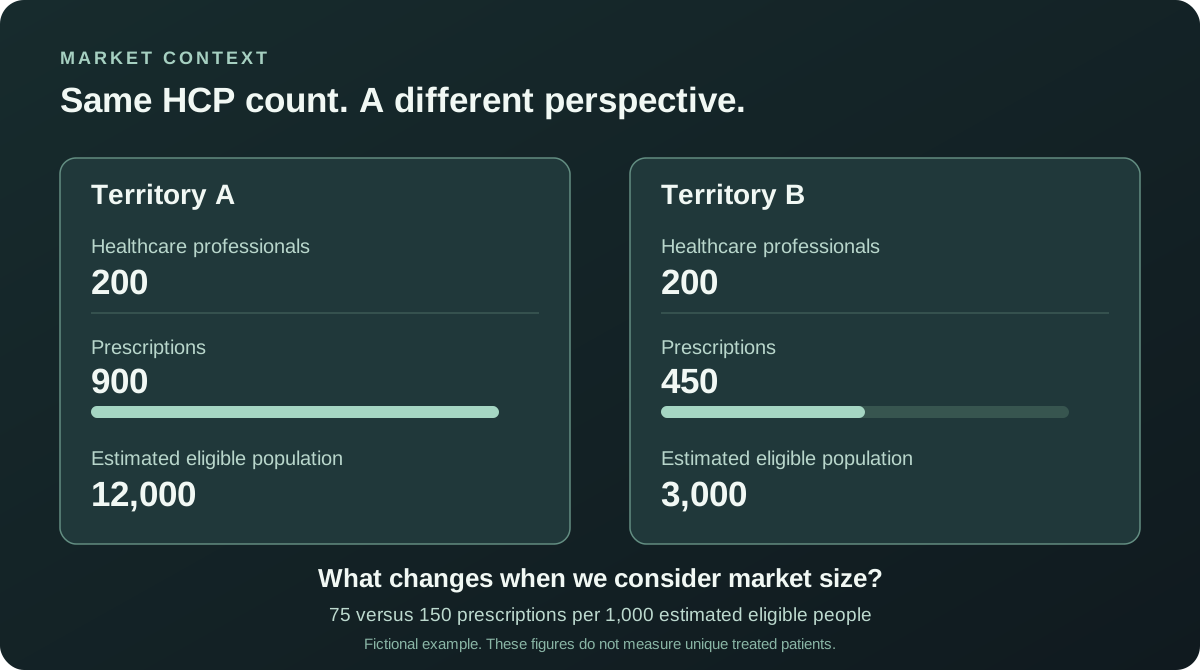
Adding an estimated eligible population changes how we interpret prescription volumes. The figures are fictional and do not represent unique treated patients or market penetration.
Territory A has twice the prescriptions, but also four times the estimated eligible population.
If we compare prescriptions per 1,000 estimated eligible people, Territory B has the higher relative volume.
Does that make Territory B more successful?
Not necessarily.
The territories may differ in disease characteristics, access restrictions, treatment duration, competitive products, or the availability of specialists.
Even the estimates of eligible patients may contain uncertainty.
Analytics becomes useful when it helps us move beyond the first, most obvious interpretation.
What is the business actually trying to achieve?
Pharmaceutical commercial teams make decisions with incomplete information.
They need to understand their markets, plan product launches, allocate resources, identify potential barriers, and monitor how conditions change.
Customer analytics supports several important questions.
Where might the opportunities be?
A territory with relatively low prescription volume might have limited demand. Alternatively, it may have a large relevant patient population but significant access barriers or low product availability.
Understanding that difference matters when planning commercial activities.
Where are the barriers?
A medicine can be clinically appropriate and still be difficult for patients to access.
Coverage restrictions, reimbursement processes, availability, and local healthcare arrangements may all influence what happens in a particular market.
Customer analytics helps teams identify patterns worth investigating rather than treating every difference as a sales problem.
Are our activities reaching the intended audience?
Commercial teams may need to understand how their permitted engagement with healthcare professionals is distributed across regions, specialties, and customer segments.
But counting interactions is not enough.
A high number of calls or meetings doesn’t automatically mean those interactions were useful, appropriate, or responsible for changes in prescribing.
What is changing over time?
A successful product launch requires more than a promising first month.
Commercial teams need to understand whether market demand, product availability, prescribing patterns, and access conditions are changing.
They also need to distinguish ordinary fluctuations from patterns that deserve closer investigation.
From reporting to better decisions
These questions illustrate why customer analytics is more than collecting data and producing dashboards.
A report can tell us that prescription volumes increased.
Customer analytics adds context: which customers, which territories, which products, what market conditions, and over what period?
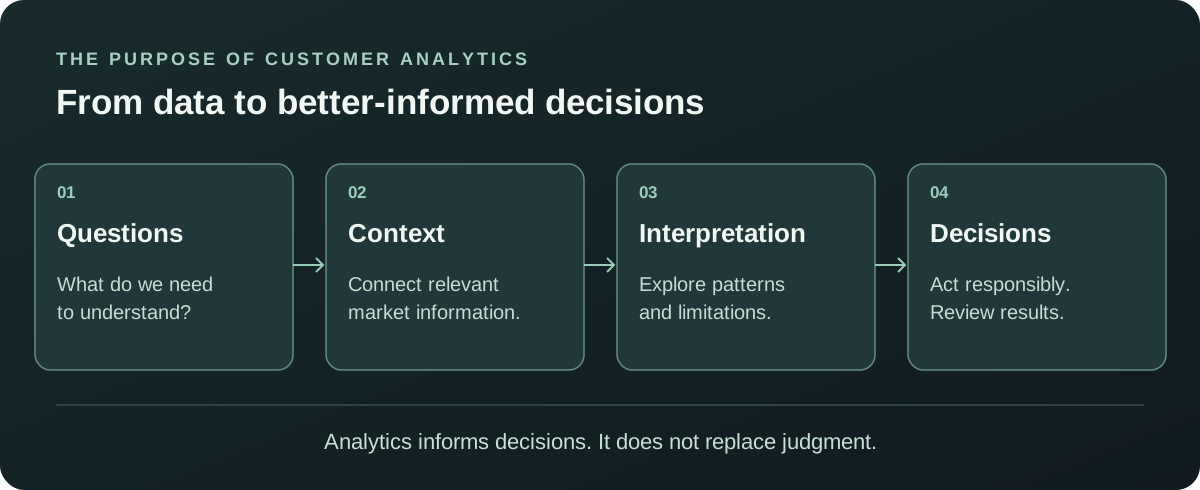
Analytics connects business questions with relevant evidence. Interpretation and professional judgment remain essential.
Technology helps by bringing relevant information together, applying consistent definitions, examining trends, and making analytical results accessible.
But data alone doesn’t make decisions.
Business expertise, medical and regulatory boundaries, and an understanding of the data’s limitations remain essential.
The idea to take away
Pharma customer analytics exists because commercial decisions cannot be made reliably from isolated numbers.
More prescriptions don’t necessarily mean better performance. More customer interactions don’t necessarily mean greater impact. And a territory with lower sales isn’t automatically a territory with greater opportunity.
The value of analytics is in understanding the context behind the numbers.
But pharmaceutical companies have been asking these questions long before modern cloud platforms, sophisticated dashboards, and AI became available.
How did they traditionally answer them?
That’s where our next article begins: From Spreadsheets to Strategy: How We Got Here.